After surpassing the milestone of 100 million users worldwide, Notion's official Chinese version finally appears to be on the horizon. For the vast Chinese-speaking user base, this represents not just a language change, but a major leap in experience and functionality. At the same time, Notion is also planning a series of AI feature updates that will further enhance user productivity.
These changes signal that Notion is continuously adapting to the needs of the global market, especially the expectations and needs of Chinese-speaking users. With these new features rolling out, how will Notion redefine the future of productivity tools?
Latest News on the Chinese Version
There have been 2 big pieces of news about Notion recently:
- Notion's global user count has surpassed the 100 million mark
- An official Chinese version of Notion is expected to be updated in August this year
Putting these two pieces of news together feels somewhat surreal — both astonishing at Notion's rapid growth and puzzling at how long the Chinese version has taken. Regardless, good things are worth the wait, and we've finally arrived at this moment.
The Chinese version news comes from Linmi, the head of the Notion Chinese community (unofficial in nature), originally posted on Jike (a Chinese social media platform).
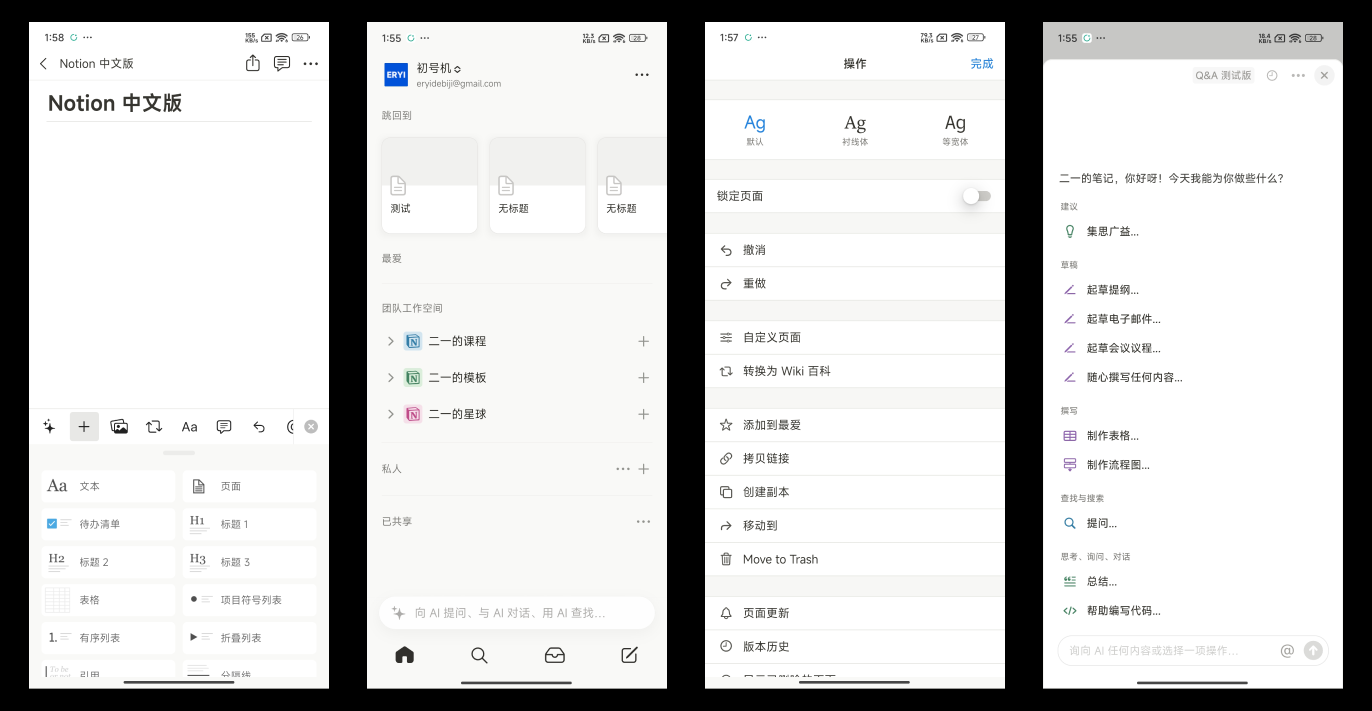
Although similar news circulated back in 2021, the confident tone and discussions in the community this time suggest that the Chinese version has a very good chance of arriving in August this year. As a Notion course creator, I'm genuinely happy — I finally won't need to spend time writing localization tutorials anymore. I also immediately previewed the Chinese version on the Android beta.
I know many English speakers can't relate, and some like to say "it's just a few words, how hard can it be to memorize them?" I'd suggest trying to switch Notion to German or Japanese — without a foundation in those languages, it's genuinely difficult to get by.
Language is, after all, the vessel of thought — when the language barrier exists, everything becomes difficult, and people give up before they can even appreciate what Notion has to offer.
So with the Chinese version coming, does this mean Notion might enter the Chinese market? Will the slow access speed issue be resolved?
The fact is, releasing a Chinese version and entering China are two completely separate things. There are large numbers of Chinese-speaking users outside of China. Products like Facebook and X all support Chinese, but they don't target the Chinese market.
So Notion's previous lack of a Chinese version didn't mean disrespect toward Chinese users. Rather, it was a matter of treating all Chinese-speaking users equally from a business perspective — Chinese language support simply wasn't high enough on the commercial priority list.
Furthermore, if Notion wants to enter China, the regulatory hard requirement is that Notion would need to host its servers in China. Both the best and worst examples can be seen in Evernote and Yinxiang Biji (the Chinese version of Evernote).
In 2018, Evernote split into Evernote and Yinxiang Biji to enter China, with each operating independently. Today, Evernote has long since lost its former glory, ending up being acquired — its era is over. Meanwhile, Yinxiang Biji has become a textbook example of poor monetization practices, focusing entirely on pushing users to pay for more premium memberships.
So personally, I don't actually look forward to Notion entering China. Looking back at past cases, I can only pessimistically assume there's a high probability it would go wrong.
Notion Surpasses 100 Million Users
On July 23, Notion CEO Ivan Zhao announced on Twitter that Notion's global user count had surpassed 100 million, and reflected on the milestones of when Notion first reached 1,000 and 1 million users:
Given Notion's current scale, we can no longer describe it simply as a "note-taking app." I believe Notion's potential extends far beyond what we see today — what it might grow into in the future is something truly worth looking forward to.
AI Feature Updates
Earlier this month, Notion officially announced that it now uses the GPT-4o AI model. In practice, Notion AI's response speed has improved dramatically compared to when it first launched, and the quality and accuracy of its answers have also improved.
Additionally, the Q&A button in the bottom-right corner of Notion now features a set of default questions (prompts) that let you directly ask questions about and summarize the current page.
A new Notion AI tab has also been added in the top-left corner. Clicking it displays all your conversation history, allowing you to use Notion AI just like ChatGPT — a massive improvement to the experience.
Notion Calendar Android Version
This month, Notion finally released the Android version of Notion Calendar. I've been frequently experimenting with using the calendar to manage my schedule and tasks recently. After using it for a while, I find that compared to to-do items with floating deadlines, a calendar provides a more intuitive sense of urgency on the time dimension.
Notion Embeds the Full Template Marketplace
Notion has added a Templates button in the bottom-left corner of the sidebar. You can now browse all templates from the template marketplace directly within the Notion app, and preview template effects right inside Notion — very convenient.
The original template button was in the top-left corner of the app and only featured official Notion templates. Now it connects to the vast web-based template marketplace, with all third-party creator templates directly embedded into Notion itself, making template access much more convenient.
Other News
Notion acquired the encrypted email service company Skiff, which at the time led to speculation that Notion might be developing its own email service.
This month, X user @ajambrosino posted that a Notion Mail icon appeared among his Mac applications, which virtually confirms that Notion is indeed developing a Notion Mail product.
That's all for this month's update. See you next time!
📘 FLO.W — Notion Personal Management System
FLO.W is a Notion-based personal management template that integrates tasks, notes, projects, habits, and more, complete with comprehensive tutorials.